
Charlton House and Albany House get 182 council rent homes, 29 fewer than approved, after the blocks were lowered below 18 metres. Work starts in September.
Hounslow Council has appointed Higgins Partnerships to build 182 council rent homes on the cleared Charlton House and Albany House site on Brentford High Street, announcing the contract on 10 August. Construction starts in the autumn, six years after Cabinet approved the estate regeneration programme that put Charlton and Albany in it, and 15 months after the demolition machines arrived.
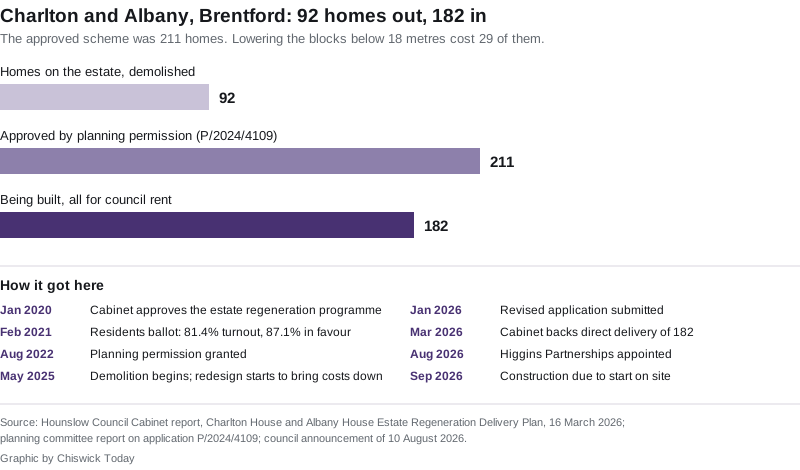
The number to hold on to is not 182. It is 29, the number of homes the scheme lost between the version that has planning permission and the version now being built, and the council’s own Cabinet report explains exactly why.
Why the scheme shrank
The consented scheme for the site is five blocks of one to eight storeys containing 211 homes, all of them affordable, approved as a variation of the original 2022 permission and reported to the planning committee under reference P/2024/4109.
That version turned out to be unaffordable. The council appointed a contractor in October 2023 under a pre-construction services agreement, and, as the Cabinet report of 16 March 2026 puts it, “the contractor’s 80% cost certainty submission was unaffordable within the parameters of the funding available within the 2025 HRA Business Plan”. That agreement was terminated once the design reached RIBA Stage 4, and a new professional team was appointed in May 2025 to redraw the scheme inside the money available.
The single biggest change was height. The redesign brought the buildings below the 18 metre threshold at which a block becomes a High Risk Building under the Building Safety Act 2022, which would have required a Gateway 2 submission to the Building Safety Regulator before construction could start. In the report’s words, “this height reduction necessitated a reduction in total residential units from 211 to 182”. Building footprints were also adjusted to keep clear of a Thames Water exclusion zone and avoid paying for diversion works, and balconies, loggias and columns were simplified to cut construction complexity.
The proportion of larger homes was protected through that exercise: more than 30 per cent of the 182 will have three bedrooms or more.
The deadline behind the timetable
The council is not free to take its time. Grant funding secured from the Greater London Authority and the London Economic Regeneration Fund is, the report says, “contingent on development commencing by September 2026”, and the loss of that grant is listed on the report’s own risk register. Cabinet was warned in October 2025 that any delay in appointing a main contractor risked forfeiting the money and could “render the project undeliverable in its current form”.
That is why the sequence has been so tight. Three contractors were tendering, tenders were returned on 9 March 2026, evaluation ran to April, and the revised planning application, reference P/2026/0045, was submitted on 8 January 2026. It has not appeared on any Hounslow planning committee agenda between April and August 2026, so any decision on it will have been taken by officers under delegated powers rather than by councillors. You can look the reference up on the council’s own planning search.
What is being replaced, and what replaces it
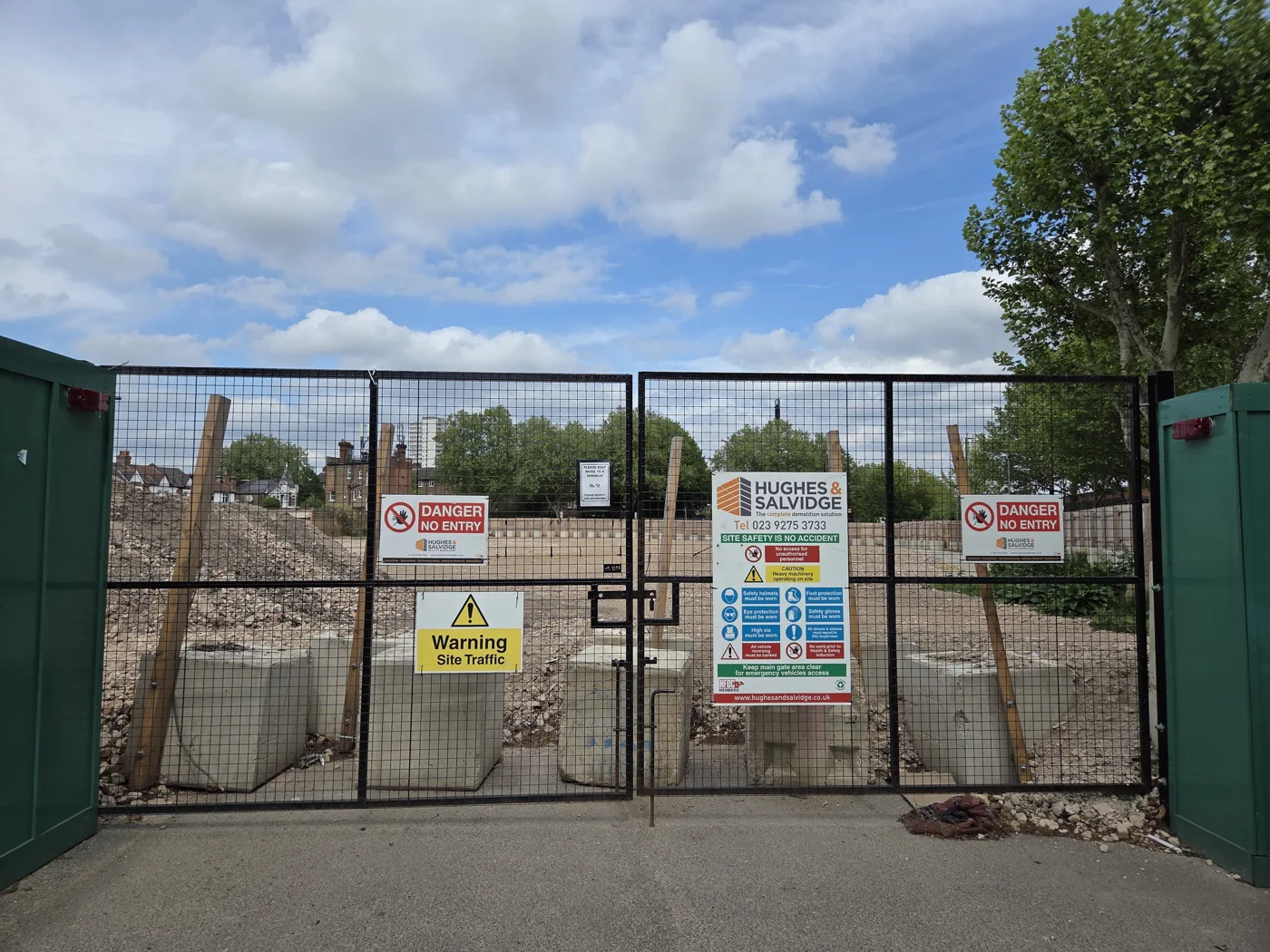
Charlton House was a central eight storey block of about 36 metres with two lower wings, holding 68 homes above 19 commercial units, alongside the four storey Albany House and Osier Court. The council counts 92 homes on the estate in total. Demolition began in May 2025 and was due to finish by March 2026, which is why the High Street frontage at Albany Parade has been hoarding and hardcore for the past year.
The replacement is 100 per cent affordable housing for council rent, with ground floor commercial space to re-provide the neighbourhood centre, including a convenience store unit, and more than 2,500 square metres of landscaped green space on an estate the council describes as previously “dominated by car parking”. The locally listed Royal Horse Guardsman pub at the north east corner of the site stays. The scheme is car free apart from on-street resident bays and blue badge provision.
Higgins says it will provide work experience placements for local residents, business advice for community enterprises and more than 750 volunteering hours during construction.
The residents, and the vote
This was not a scheme imposed without a mandate. The estate held a ballot in February 2021 with a turnout of 81.4 per cent, and 87.1 per cent of those voting backed regeneration. Tenants have since been rehoused: the council used compulsory purchase powers under section 226 of the Town and Country Planning Act 1990 to get vacant possession, and the March 2026 report records that all tenants have been supported to relocate and that most home loss and disturbance payments have been made, with negotiations continuing over a small number of former tenants.
The reason the council chose to build the homes itself, rather than sell the site or bring in a joint venture partner, is set out in the same report: direct delivery “guarantees that all 182 new homes will be genuinely affordable Council housing” and lets the council use the GLA and regeneration fund grants. The scheme budget sits in a confidential appendix, exempt from publication under Schedule 12A of the Local Government Act 1972, so the cost of the job is not public.
What it means for you
If you live in Brentford West, expect a working construction site on the High Street from September and for several years after. The neighbourhood shops that were on that parade are due to be re-provided in the new ground floor units, so if you are a returning business or want one of those units, the council’s regeneration team is the contact point.
If you are on the housing register, these are the homes to watch. The council reported over 4,400 households waiting for a council home as of July 2025, and homelessness presentations up 226 per cent since 2018. Charlton and Albany counts towards a target of 1,000 new council homes across the borough.
There is a cost side that reaches every council tenant in Hounslow, not just Brentford. The borrowing that part funds this scheme was signed off in the 2026 Housing Revenue Account business plan on the assumption of annual rent rises at September CPI plus 1 per cent, rent convergence adding £1 a week in 2027/28 and £2 a week in 2028/29, and £3m of HRA savings. Those are the terms on which the council’s building programme is affordable to itself.
For what else is coming through the system near you, see our Chiswick planning news page, and for what homes are actually selling for locally, our Chiswick house prices page.
Have your say