
Hounslow beat the national figure on all four GCSE measures the council published. We checked each one against the JCQ national tables: three match to the decimal, one does not.
Hounslow’s GCSE candidates came out ahead of the national figure on all four measures the council published on results day, and the widest gap was in English.
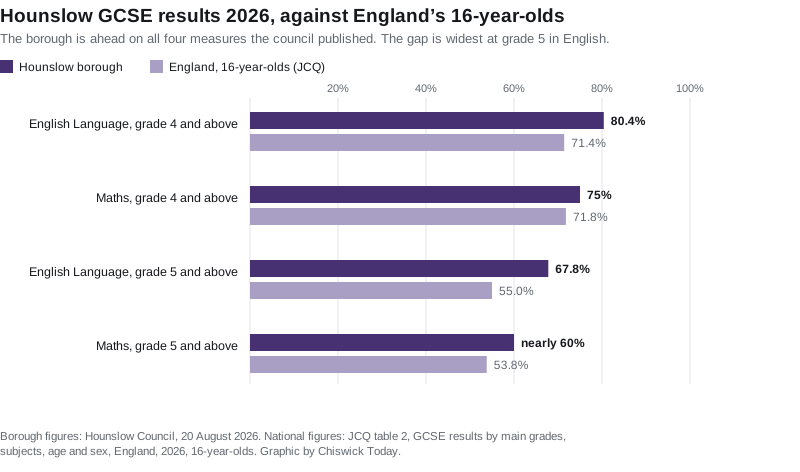
The borough says 80.4 per cent of its students reached grade 4 or above in English and 75 per cent did so in maths. At grade 5 or above the figures were 67.8 per cent in English and, in the council’s words, nearly 60 per cent in maths (Hounslow Council, 20 August 2026).
We checked the council’s national comparators
A results-day release is only as good as the number it measures itself against, and councils do not always name the source. Hounslow’s did not.
So we downloaded the national tables. The four figures the council quotes line up with the Joint Council for Qualifications table 2, which reports GCSE results by subject, age and sex for England. The rows that match are the ones for 16-year-olds, not for entrants of all ages.
That matters, because the all-ages figures are much lower. Resit candidates sitting English and maths again at a college are counted in them. In England this summer, across all ages, 59.5 per cent of English Language results and 57.2 per cent of maths results reached grade 4. For 16-year-olds the same two figures are 71.4 per cent and 71.8 per cent.
Set against the 16-year-old rows, three of the council’s four comparators are exact:
| Measure | Council’s national figure | JCQ, England, 16-year-olds |
|---|---|---|
| English, grade 4 and above | 71.4% | 71.4% |
| Maths, grade 4 and above | 71.7% | 71.8% |
| Maths, grade 5 and above | 53.8% | 53.8% |
| English, grade 5 and above | 55.3% | 55.0% |
The last row is the odd one. JCQ puts English Language at 55.0 per cent for 16-year-olds at grade 5 and above, not 55.3. The difference is small and it does not change the picture: Hounslow’s 67.8 per cent clears either number by more than twelve points. The council’s release does not say which table it drew on.
What the official statistics do not publish
Two things are worth knowing before anyone compares Hounslow with the borough next door.
- There is no local authority breakdown. Ofqual’s data tables for summer 2026 report GCSE outcomes by region and by centre type, and nothing smaller. No official table gives a figure for Hounslow, Ealing or Hammersmith and Fulham, so the borough’s own 80.4 per cent cannot be checked against a published national dataset.
- Ofqual publishes no subject-level or grade-5 figures at all. Its tables run to grade 7 and above and grade 4 and above, for all subjects combined. The words “grade 5” do not appear anywhere in the workbook. Any English-only, maths-only or grade-5 national comparator has to come from JCQ, as Hounslow’s does.
Ofqual’s own regional table is still useful as context, and it flatters the borough’s neighbourhood rather than the borough. Across all subjects, London’s 16-year-olds got 75.5 per cent of their results at grade 4 or above this summer, against 70.7 per cent for England (Ofqual, qualification results in England, summer 2026, tables 19a and 19b). London has been roughly five points clear of the country for four years running. A London borough ahead of the England figure is doing what its region does.
Springwest and Learn Hounslow
The council’s release led on Springwest Academy in Feltham, headlining a student who came away with grade 9 across the board. Simon Hart, the principal, is quoted saying: “We are delighted with our pupils and staff, these are our best ever results as a school.”
Learn Hounslow, the council’s adult and community learning service, reported a 100 per cent pass rate in GCSE English Language and maths.
Councillor Shantanu Rajawat, the leader of the council, said: “I want to congratulate all those who have worked hard and shown incredible dedication in their studies.”
Individual schools mostly stay quiet. Chiswick School’s website carried no summer 2026 GCSE figures when we checked on 23 August. That is normal: most secondary schools publish a photograph and a headteacher’s message rather than a percentage, and the ones that do publish use bases that are not comparable with each other. Some report the share of grades, some the share of students, some English and maths together.
Why the league tables will look odd this year
Parents comparing schools this autumn should know that one of the two headline measures has gone missing, and it is the one that adjusts for how far pupils have come.
The Department for Education states plainly: “It is not possible to calculate Progress 8 for academic years 2024 to 2025 and 2025 to 2026, as there is no Key Stage 2 (KS2) prior attainment data available to use to calculate Progress 8” (DfE, secondary accountability measures guidance, 16 October 2025). This year’s Year 11 sat no KS2 tests, because they were cancelled during the pandemic.
Attainment 8, the EBacc measures and the English and maths figures still publish. Progress 8 does not. Attainment-only tables tend to favour schools with a more advantaged intake, so a school that adds a lot of value will have no measure that shows it.
The DfE’s own national figure for the current summer is not out yet either. Its per-pupil English and maths measure for 2025/26 is due in October.
What it means for you
If a grade looks wrong, the deadline is closer than most families think.
- Both post-results services close on 24 September 2026. A clerical re-check is turned around in 10 calendar days, a review of marking in 20 (JCQ post-results services).
- The priority service does not cover GCSE. It closed on 20 August and applies to A level, AS and level 3 vocational qualifications only.
- Requests go through the school, not direct to the exam board, and the school needs the student’s written consent first.
- A grade can go down as well as up. JCQ requires candidates to understand that before they consent.
Anyone who missed grade 4 in English or maths can resit in November. Entries go through the school’s exams officer.
For the wider picture in the borough, our Hounslow claimant count breakdown shows how differently the east and west of the borough are faring, and our Chiswick house prices page has what W4 homes actually sell for.
Have your say